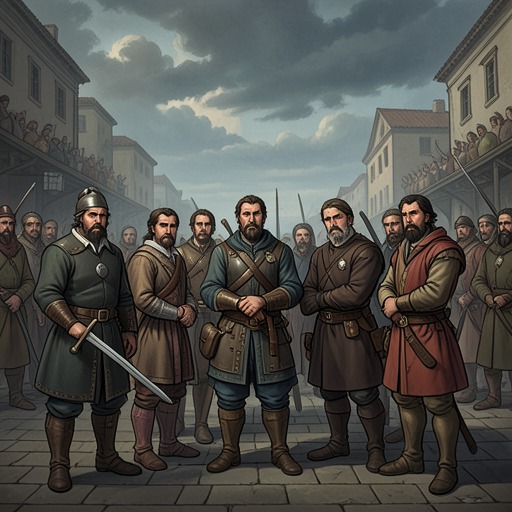
The culture of dueling
The Three MusketeersThe culture of dueling is one of the governing practices of the novel’s world: a forbidden form of violence that nevertheless functions as a recognized language of honor, courage, rank, rivalry, and allegiance. It turns insult into action, makes the body the measure of reputation, and allows men to resist humiliation even when the law forbids them to fight. Its contradictions are central to the careers of d'Artagnan the younger, Athos, Porthos, and Aramis, whose combats begin in misunderstanding but become the foundation of their fellowship.## Honor, Courage, and the Gascon Code The code is first transmitted to d'Artagnan the younger as paternal instruction. M. d'Artagnan the elder tells his son that a gentleman must endure nothing from anyone except the king, the cardinal, and M. de Treville, and that courage alone can enable a man to make his way. He urges the young man not merely to avoid quarrels but to seek adventures, to fight on every occasion, and to fight all the more because duels are forbidden. The prohibition does not lessen the moral value of combat in this code; it intensifies it by making a willingness to fight appear evidence of exceptional courage.
This teaching joins personal bravery to inherited identity. d'Artagnan is expected to act courageously because he is a Gascon and because he is his father’s son, while the family’s ancient nobility gives him a claim to conduct himself as a gentleman. The father can offer little material support beyond fifteen crowns, a horse, and a healing balsam, but he presents the rules of honor as a form of capital more valuable than money. The young man’s later conduct shows how completely these lessons have entered his judgment: even when facing probable death, he repeats the principle that he must endure nothing from anyone except the king, the cardinal, and M. de Treville.## The Duel as Social Performance Dueling is not confined to private spaces. The king’s Musketeers and the Cardinal's Guards carry their rivalry into cabarets, public walks, and public sports. The Musketeers shout, twist their mustaches, clash their swords, and deliberately provoke the Guards whenever they meet. Combat may occur openly in the streets, sometimes resulting in death, yet the consequences are distributed according to allegiance. A Musketeer who kills may be protected from prison, while one who is killed is certain to be mourned and avenged. The duel therefore operates as both individual contest and group theater: every fighter represents a company, a patron, and a political household.
The code also depends upon display. Porthos’s encounter with d'Artagnan is triggered by a collision at M. de Treville’s residence, but the comic accident exposes how much reputation rests on costume and appearance. D'Artagnan becomes entangled in Porthos’s cloak and finds his face pressed against the celebrated baldric. The baldric glitters with gold in front but is plain buff behind, revealing that Porthos can afford only half the luxury he displays. The object is not incidental. It shows how the culture of dueling joins physical danger to masculine pageantry, making clothing, posture, and visible magnificence part of the contest before swords are even drawn.
D'Artagnan’s first morning in Paris demonstrates the speed with which this system converts social error into mortal risk. After running headfirst into Athos’s wounded shoulder, he collides with Porthos and insults the appearance of Porthos’s baldric. Before the morning is over, he has arranged two duels with men he regards as formidable enough to kill several men like himself. He does not regard these appointments simply as foolish accidents. He is ashamed of his conduct, understands that he has caused Athos severe pain, and nevertheless proceeds toward the Carmes Dechausses, the customary dueling ground for men who have no time to lose. The wounded Athos waits there punctually at noon, showing that the code gives ritual form even to a quarrel born of accident.## Law, Authority, and Political Rivalry The culture of dueling is defined by a conflict between public law and private enforcement. When Athos and d'Artagnan are discovered in fighting positions, Jussac of the Cardinal's Guards invokes the edicts against them and orders them to sheathe their swords and follow the Guards. Athos answers with rancor, especially because Jussac had attacked him the preceding day, and refuses to treat the intervention as neutral. The Guards claim duty, but their appearance also reveals that the state’s condemnation of dueling is inseparable from competition between armed factions.
Louis XIII and Cardinal Richelieu reproduce this contradiction at the highest level. Louis XIII surrounds himself with the Musketeers, while Richelieu creates a rival body of Guards and recruits celebrated swordsmen from the provinces of France and from foreign states. The two political rivals may denounce duels and brawls publicly, yet they secretly encourage their servants to quarrel. Their private chess games become occasions for boasting about the bearing and courage of their men, and victory or defeat among retainers gives the rulers personal satisfaction or regret. Combat is thus officially illegal but politically useful: the state condemns unauthorized violence while cultivating controlled violence through competing households.
M. de Treville understands this structure and turns it into power. His Musketeers are loose, half-drunk, imposing, and largely undisciplined toward everyone except their captain. They adore him, tremble before his commands, and are ready to sacrifice themselves to erase the smallest insult. Treville uses this force first for the king and the king’s friends, then for himself and his own friends, but the narrative distinguishes his influence from mere corruption: he is not accused of exploiting his followers for personal gain. His authority rests on reciprocal loyalty. He protects men who fight, and they make his protection possible by converting private courage into a disciplined political instrument.
Treville’s position also clarifies why dueling is a path to advancement as well as danger. His repeated combats, together with his loyalty and promptness, help carry him to the captaincy of the Musketeers. M. d'Artagnan the elder presents him as a model for his son: a man who began with little, fought repeatedly despite royal edicts, and rose to command a celebrated military body. Dueling culture therefore promises social mobility, but only for those able to transform violence into recognized service, patronage, and reputation.## From Rivalry to Fellowship D'Artagnan’s projected duels with Athos, Porthos, and Aramis initially place him against the very men he most admires. He expects Athos to kill him, hopes that an explanation might win Athos’s friendship, plans to use the baldric episode to embarrass Porthos, and considers striking Aramis in the face to damage the beauty of which Aramis is proud. Each opponent is understood through a distinctive vulnerability: Athos’s wound, Porthos’s vanity, and Aramis’s appearance. The duel begins as a mechanism of separation, sorting men into enemies according to insult and pride.
The confrontation changes when the Cardinal's Guards arrive. Athos and d'Artagnan are no longer merely individuals contesting a private offense; they face a common external authority that seeks to arrest them. Their shared resistance shifts the value of the scene from personal honor to collective allegiance. Porthos and Aramis, who had been d'Artagnan’s intended opponents, become companions in the same danger. The culture of dueling consequently produces an irony at the heart of the novel: a ritual designed to defend individual reputation becomes the route by which four men recognize a larger loyalty.
The same code permits violence to become communal memory. When a Musketeer is killed, he is mourned and avenged; when a Musketeer kills another, Treville is expected to prevent him from rotting in prison. Such responses make every duel consequential beyond the instant of combat. An insult can call forth retaliation, retaliation can demand protection, and protection can deepen the bond between a captain and his men. The phrase that later defines the four companions is prepared by this structure, in which danger is never entirely private and honor is sustained collectively.## The Body as Evidence and Punishment Dueling culture treats the body as the visible site where honor is defended, damaged, and interpreted. D'Artagnan’s sword is broken by a stick during his encounter with the stranger at Meung, and a second blow to his forehead leaves him bleeding, nearly fainting, and carried into the kitchen by the innkeeper’s servants. The broken weapon and wounded forehead make his defeat physically legible, but they do not produce surrender: he never cries for quarter. Courage is measured not by invulnerability but by refusing to yield while the body is failing.
The culture’s bodily logic extends beyond formal duels into marks imposed by authority. When d'Artagnan discovers the fleur-de-lis on Milady the English spy’s shoulder, a concealed mark becomes decisive evidence of a secret identity and a terrible past. The exposure freezes him and makes Milady understand that her hidden history has been revealed. The mark reverses the usual relation between body and reputation: rather than earning honor through combat, the body bears an imposed sign that can determine how a person is judged.
Milady’s response to captivity shows her adapting the same logic of combat to conditions in which she cannot openly fight. She rejects violence as proof of weakness and decides that, against men, her strength lies in weakness. She studies her face, changes its expressions from anger to affection, arranges her hair, and reassures herself that she remains beautiful. Her strategy turns appearance into a weapon comparable to the sword. The duel has moved from the street into the prison room, but the underlying contest remains one of control, vulnerability, and survival.
The final punishment makes the body a public instrument of judgment. Milady is bound hand and foot on the riverbank and protests that ten men have joined to murder one woman, warning that she will be avenged if she is not saved. Athos rejects her claim to the identity she invokes, declaring that she is not a woman but a demon to be sent back to hell. The scene exposes the culture’s darkest extension: the language of honor and retribution can authorize extrajudicial violence, while the condemned body is denied the protections ordinarily attached to personhood. Dueling begins as a forbidden test of courage and ends, in this instance, as a collective execution whose participants claim moral authority over life and death.